Written procedures for agents: what Skills over MCP changed in October
The first integration usually goes well. You connect the CRM, the agent reads an account and writes a note. The trouble tends to start around the fourth. Eight systems can easily mean eighty tools, and every one of those descriptions sits in front of the model on every request. The agent knows how to call each tool. What nobody has written down for it is the order your company calls them in, and the rules that apply along the way.
In October, an answer to that gap moved from specification into production use.
What changed, and when
MCP (the Model Context Protocol) is the open standard agents use to connect to outside systems. Its Skills extension lets a server publish documented workflows alongside its tools. SEP-2640, the proposal behind it, has Final status, and the specification is maintained by a working group in the public ext-skills repository.
Three dates in October made it concrete:
- 10 October. Cloudflare's API MCP server began
serving its own skills
through the extension. A supporting client lists them and reads the files at
skill://addresses. - 19 October. The same server gained step-up authorisation. You connect with minimal access, and the server asks for a further permission only when a tool call needs it.
- 29 October. In Cloudflare's Agents SDK, skills became plain files in the agent's workspace. The changelog says no build step or deploy is needed and that the agent can write its own skills. It requires Agents SDK v0.32.0 or later.
The mechanism
A skill is a folder containing a SKILL.md file. The file opens with two required fields, a
name and a short description, followed by instructions in plain Markdown. The format is set out in the
Agent Skills specification.
What makes it useful is progressive loading, in three tiers:
- At start-up only the name and description load, roughly 100 tokens per skill.
- The full
SKILL.mdbody reaches the model when the agent activates that skill. The recommended size is under 5,000 tokens. - Supporting files are read only when the task requires them.
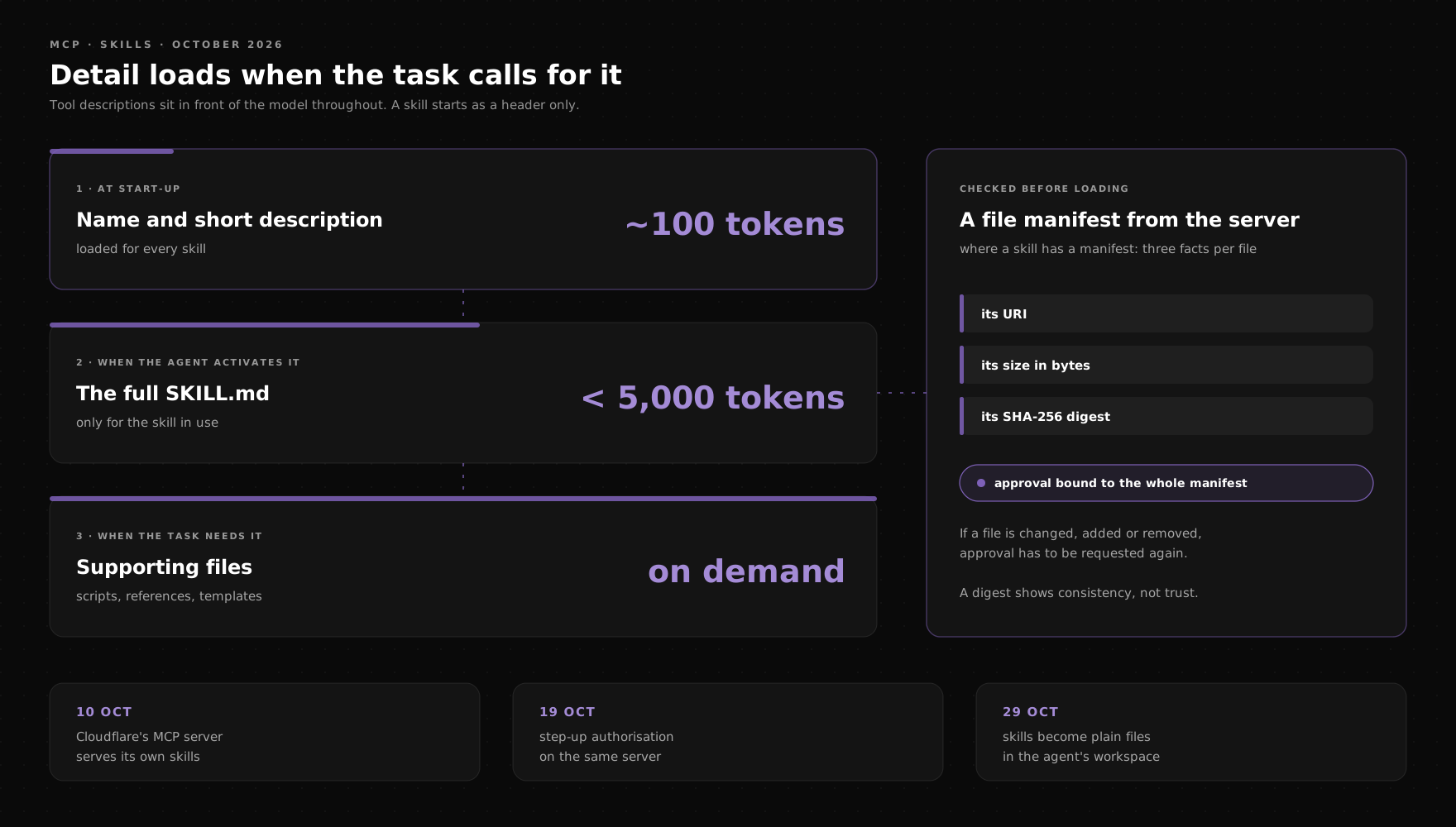
Only the header loads at start-up. The detail arrives when the task calls for it.
The headers of twenty skills come to around 2,000 tokens. Tool descriptions, by contrast, stay in front of the model throughout.
Why a business should care
A smaller standing cost. Whatever sits in front of the model is paid for on every request. With progressive loading, a written procedure takes up space only while it is in use.
The procedure exists in writing, and its changes are visible. A SKILL.md is a text file.
It can go into version control, a colleague can read it, and the history shows who changed
what.
Where a skill has a manifest, you can check what the agent loaded. The server lists every file with its URI, byte size and SHA-256 digest. The specification requires the host application to verify size and digest before use, and ties the user's approval to that complete manifest. If a file is changed, added or removed, that approval lapses and has to be requested again. The exception is a skill whose content is generated on the fly: it carries no stable digests, a host may decline it, and an earlier approval does not cover whatever it serves later.
Where it is useful
The obvious case is your own house rules. How a quote is built: which discount bands exist, when a second approval is needed, which template it lands in. How a new customer is set up: which fields are mandatory, what is checked against Companies House, what happens when there is no match. As a skill it is written once, and every agent reads the same version.
The same applies to data work. The four Apify Actors we use to turn a list of businesses into an account view form a sequence, with rules for what to do when a step returns nothing. Rules of that kind belong in a skill file.
Limits and risks
Client support is incomplete. This is the caveat that matters most. On 11 November the official implementations list showed three of the nine official SDKs (TypeScript, Python and C#) as having implemented the extension, with only the TypeScript one shipped in a release; the Python and C# work was merged but not yet released. Five more were in progress and one was planned. Among widely used clients, the client matrix recorded support only for ChatGPT, and marked it partial; the rows for Claude, Cursor and VS Code were empty on the same day. If you are planning now, plan for the format, and do not assume every client you use will read it.
Skill content is untrusted input. The specification says so directly. Hosts must treat it as untrusted, host-side code execution and pre-approved tool grants need explicit approval for each skill, and a skill is identified by its originating server together with its URI, since a name alone is not unique. A digest shows that a file matches the server's manifest. Whether the content deserves trust is still your decision, and a workflow from someone else's server warrants the same reading as a script from the same source.
One change affects older set-ups. Since 22 October, Cloudflare's product-specific MCP
servers
return 410 Gone on the old /sse path.
A client still configured with that address needs moving to the /mcp one.
Our read on it
Skills address a gap that often stalls in-house agent projects: the tool is there, but the way to use it is not written down anywhere it can be tracked and checked. The format is a plain text file and ties you to no vendor, so writing your procedures this way is worthwhile even if your client cannot yet load them from a server. We would not build a production process on client-side support as it stands today.
For a look at how a tool reached over MCP behaves in practice, we wrote up a run of our own public one: Tribloc Lead Intelligence in ChatGPT.
We'll build this for your business too.
Free consultation: 15 minutes, a concrete recommendation, no obligation.