GEO or rebranded SEO? Four questions that tell them apart
When we asked ChatGPT about GEO providers in Hungary on 3 September 2026, its answer ended with a warning of its own: the GEO label is new and widely used, so it's worth checking whether you're getting real GEO work or rebranded SEO and content marketing.
Fair point. The harder question is how someone who isn't a specialist can tell the difference. The four questions below fit into a first call, and each deserves a specific, dated answer.
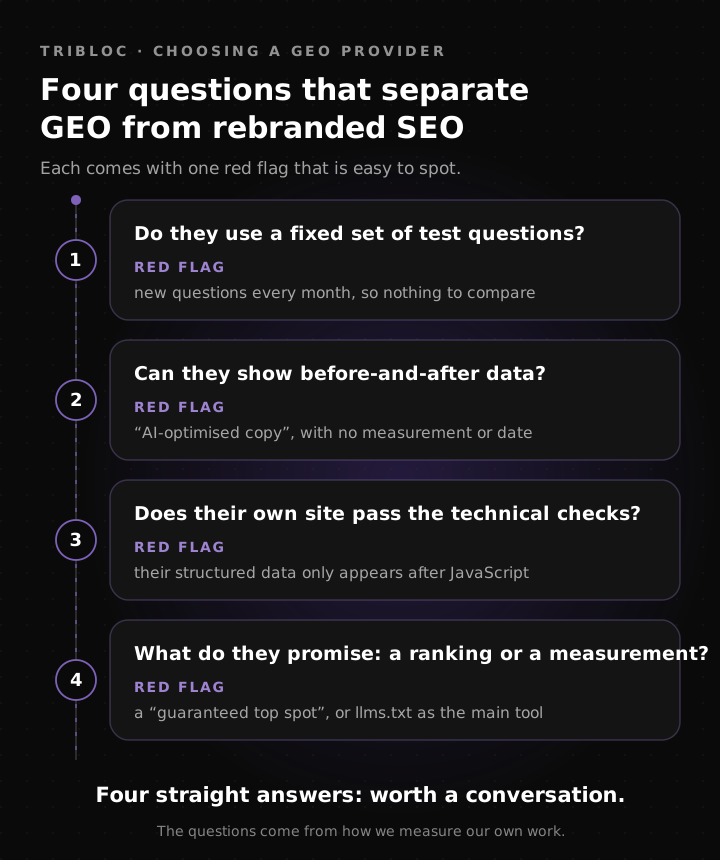
The four questions, each with its most common red flag.
What's the difference between SEO and GEO?
SEO is about whether your site makes it into a search engine's results. GEO is about whether AI search tools (ChatGPT, Gemini, Perplexity, Copilot) name your business in their answers and cite your website as a source.
One sits on top of the other. These tools gather conventional search results to build their answers, so a site that doesn't make it near the top of those results is hard for the answer to cite. Anyone telling you SEO is dead and GEO replaces it has misread how the tools work.
GEO adds five things on top of solid SEO:
- Connected business data: your site's structured data links to your Google Business Profile, LinkedIn and directory listings, and your name, address and phone number match everywhere.
- Mentions elsewhere: answers to “who's the best X near me” are largely assembled from list articles, directories and industry sites.
- Extractable text: question-style headings, with the answer in the first two or three sentences underneath.
- Citable specifics: your own measured figures, with a date and a source.
- Crawler access: the bots that fetch pages for answers aren't blocked.
Question 1: Do they use a fixed set of test questions?
Measurable GEO work starts with 10 to 15 questions, phrased the way your customers would ask them, kept the same from month to month. If the questions change every month, there's nothing to compare against, and “your visibility has improved” can't be checked.
Our own set has 15 questions and hasn't changed since 5 September 2026. New questions are added as a separate block, and the originals stay, otherwise the baseline would be lost.
Red flag: they can't tell you which questions they measure your visibility on.
Question 2: Can they show before-and-after data?
If a provider can't show that a past client didn't appear in AI answers before the work and did afterwards, they haven't shown a measurable result. At a minimum, for each question and each AI tool, you'd expect a record of:
- whether the business was named,
- whether its website was cited as a source,
- where it appeared in the answer,
- who appeared instead,
- and when the check was made.
This tracking is usually manual. AI search tools don't offer stable access for it, and automated bulk querying generally breaches their terms of use. A dated, manual log is solid evidence, as long as it's kept consistently.
Red flag: “AI-optimised copy” sold as a product in its own right, with no measurement and no dates.
Question 3: Does their own site pass the technical checks?
A provider selling GEO should be able to show it on their own site. Anyone can check four things:
- Structured data in the raw HTML. If it only appears after JavaScript runs, the crawlers behind ChatGPT and Perplexity don't see it. Here's how to check in two minutes.
- Connected business data. The structured data lists their external profiles.
- Citation crawlers allowed. Their robots.txt doesn't block them.
- FAQ markup on their frequently asked questions.
Crawlers cause a lot of confusion, because training bots and citation bots do different jobs:
| Bot | What it's for | If you block it |
|---|---|---|
| GPTBot, ClaudeBot, CCBot, Google-Extended | model training | a legitimate business choice |
| OAI-SearchBot, ChatGPT-User, Claude-SearchBot, Claude-User, PerplexityBot | fetching pages for answers | you drop out of the answers |
Blocking everything to stop AI training also switches off your visibility, and people often don't notice. A default bot-blocking setting at the host is a common cause, rather than a deliberate decision.
Red flag: the provider's own structured data only appears after JavaScript runs, or their site blocks citation crawlers.
Question 4: What do they promise: a ranking or a measurement?
AI answers vary by run, by tool and by user. Guaranteeing a top spot in them is the same kind of promise as guaranteeing the first result on Google: an outcome the provider doesn't control. What a provider can reasonably commit to is a measurement method, targeted work, and dated before-and-after data.
The other common overpromise is llms.txt, a 2024 proposal for a file that summarises a site for language models. As far as we know, by September 2026 none of the major AI search tools had publicly confirmed using it for their answers, and Google's John Mueller compared it to the old keywords meta tag in 2025. We publish one ourselves: it takes half an hour and does no harm. Selling it as the core of a GEO engagement overprices it.
Red flag: a “guaranteed top spot”, or llms.txt as the main deliverable.
How should you use the four questions?
Ask them on the first call, and ask for an example or a date with each answer. A well-prepared provider can answer all four specifically: they'll show you their question set, a past measurement, their own site, and exactly what they commit to.
Why this matters is clear from our own market check: of the five GEO providers ChatGPT named in Hungary in September 2026, the first had no working website. The full measurement is here.
Frequently asked questions
What is GEO, in one sentence?
GEO (generative engine optimisation) is the work that makes ChatGPT, Gemini, Perplexity and similar AI search tools name your business in their answers and cite your website as a source.
Does GEO replace SEO?
No. AI search tools build their answers from conventional search results, so solid SEO is a precondition for GEO. GEO adds connected business data, mentions elsewhere, extractable text, citable specifics and crawler access on top.
Can anyone guarantee I'll be first in ChatGPT's answer?
No. Answers vary by run, by tool and by user, so a top spot isn't in any provider's control. A measurement method and dated before-and-after data are what a provider can commit to.
Is publishing an llms.txt file enough?
No. llms.txt is a 2024 proposal, and as far as we know, by September 2026 none of the major AI search tools had publicly confirmed using it. It's quick to add and does no harm, but it's too thin to be the core of GEO work.
Where should my business start?
With a fixed question set and a dated baseline: 10 to 15 customer questions, four AI tools, and a record of whether you appear. Every later check is measured against it. The free AI visibility test checks your website's technical basics in a few minutes.
If you'd like to start with your own site, the free AI visibility test runs 7 technical checks on what a citation crawler can see. No sign-up needed.
We'll build this for your business too.
Free consultation: 15 minutes, a concrete recommendation, no obligation.